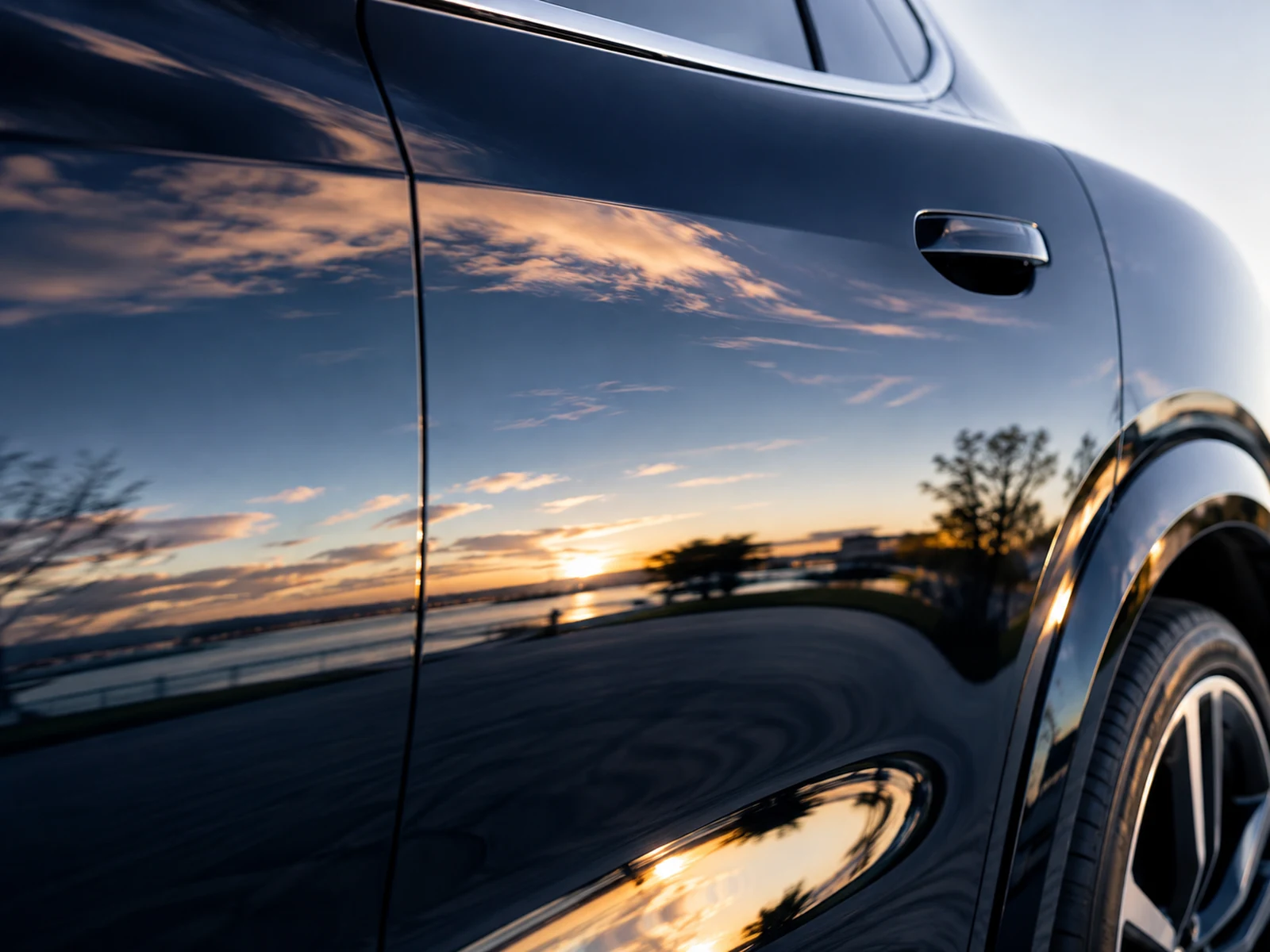
Car polishing is part of Homi's car wash and cleaning service in Amman, and it is the only one of our car services that works on the paint rather than inside the cabin. Confirm the location details when you book.
What polishing actually does
Modern car paint is built in layers: primer, then colour, then a transparent clear coat on top. Almost every mark you see on a car that has not been in an accident lives in that clear coat, not in the colour beneath it.
Polishing removes a microscopically thin layer of that clear coat with an abrasive compound and a machine, levelling the surface until the walls of each scratch are gone. Light then reflects evenly again instead of scattering, which is the whole reason the paint looks dull in the first place.
This is worth being precise about, because polishing is often sold as though it fills or covers marks. It does not. Filling is what a glaze or a wax does, and that effect washes off within weeks. Polishing removes material, which is why the result lasts and also why it should not be done casually or repeatedly. There is a finite amount of clear coat, and once it is gone the panel needs repainting.
Where the marks come from
The fine circular scratching visible on a dark car in direct sun, known as swirl marks, is almost entirely caused by washing. Dry wiping a dusty panel, a single bucket with grit in it, a brush at an automatic wash, or a cloth dropped on the ground and picked up again will each produce it.
Alongside that you get water spots, where hard water dries on the panel and leaves a mineral ring that etches in if the car is hot; bird droppings and tree sap, which are acidic and bite into the clear coat within hours; and general oxidation, which flattens the colour of older paint and is most obvious on red and black.
The process
Wash and decontaminate
The car is washed thoroughly first. Polishing a dirty panel drags grit under the pad and creates deeper scratches than the ones being removed. Bonded contamination is then pulled off the surface so the paint is genuinely smooth.
Inspection
The paint is assessed panel by panel under strong light to see what defects are actually present and how deep they run. Paint thickness matters here, especially on a car that has had bodywork.
Test section
A small area is corrected first to find the least aggressive combination of pad and compound that does the job. Starting gently and stepping up removes far less clear coat than starting hard.
Machine correction
The car is worked panel by panel, with the residue wiped off and the result checked under light before moving on. Edges, badges and trim are approached carefully because clear coat is thinnest at panel edges.
Refine and protect
A finer polish removes any haze left by the correcting stage, then a sealant or wax is applied so the corrected surface is protected rather than left bare.
What polishing cannot fix
If you can catch a fingernail in a scratch, it has gone through the clear coat and polishing will not remove it. It may look less obvious afterwards, but the mark is still there and the honest answer is that it is a paint repair, not a cleaning job.
The same applies to stone chips, deep key marks, cracked or peeling clear coat, and paint that has already been polished thin by previous owners. Dents, kerbed alloys and cloudy headlights are separate repairs. We will tell you what is correctable and what is not before any work starts.
Protecting the result
Correction is only worth doing if the washing habits that caused the marks change afterwards. Two buckets rather than one, a clean wash mitt, separate cloths for wheels, and no dry wiping of a dusty panel will keep a polished car looking polished for a long time.
The sealant applied at the end helps, but it is a sacrificial layer with a limited life, not a permanent coating. Ask about reapplication intervals when you book if that matters to you.
Sun, dust and Amman conditions
Cars here work hard. Strong year-round sun accelerates oxidation on horizontal panels, so bonnets and roofs are always in worse condition than doors. Airborne dust means panels are dusty within a day of washing, which tempts people into the dry wipe that causes swirls. And hard water leaves spots quickly on a hot panel, so a car washed in midday sun will spot before it can be dried.
The practical result is that a polished car in Amman benefits more from careful washing and shaded parking than from frequent correction. Polishing is a periodic reset, not maintenance.
How car polishing is priced
By service level and vehicle size. A single-stage polish to lift gloss and a multi-stage correction on badly swirled paint are very different amounts of labour, and a large vehicle has considerably more panel area than a hatchback. Larger vehicles are covered on the SUV cleaning page. You see the price when you book, before you confirm.
You see the price before you confirm the booking, and there are no hidden fees.
How to book
Choose car cleaning, tell us the vehicle, the paint colour and what is bothering you about the finish, and pick a date. Photographs taken in direct sunlight show defects far better than photographs taken in shade. Confirm the location details when you book. We operate 9 AM to 9 PM, seven days a week, and our mobile app is launching soon.
We cover all of Amman, including Abdoun, Dabouq, Khalda, Deir Ghbar, Shmeisani, Tla' Al Ali, Jubeiha and Sweileh.